What Healthcare Got Right About Early Warning
For decades, diagnosing illness meant waiting for symptoms to become obvious enough to act on. A patient would come in feeling unwell, a doctor would run tests, and a condition would be identified after it had already progressed. The goal of modern medical AI is to invert that process entirely: catch the pattern before the patient ever feels it.
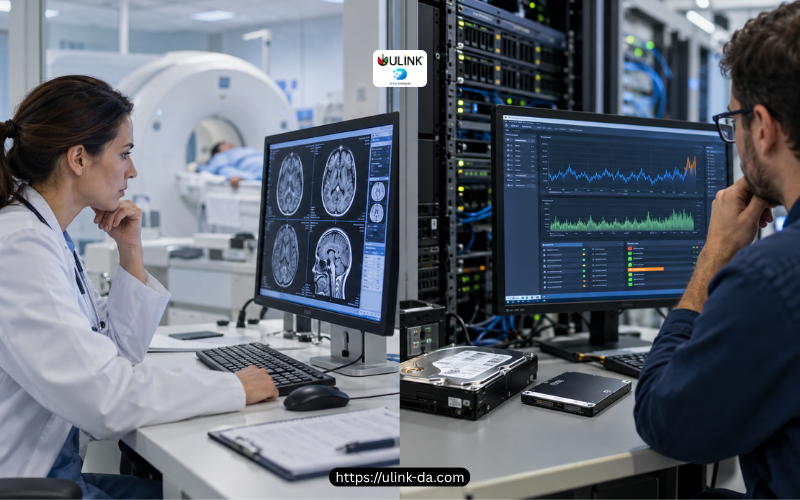
Today, AI systems in healthcare analyze thousands of data points simultaneously. Imaging AI reviews scans and flags anomalies that might be invisible to the human eye at an early stage. Predictive models combine lab results, patient history, vital trends, and behavioral signals to surface risk before it becomes a crisis. The insight driving all of this is the same: by the time a single metric crosses a threshold, the problem has often been developing for a long time.
The shift is from reactive thresholds to multi-signal trend analysis. And the results speak for themselves. Earlier detection leads to better outcomes, reduced costs, and fewer emergency interventions.
This same principle applies directly to how we think about storage drive health.
Storage Drives Follow the Same Pattern
A storage drive, like the human body, rarely fails all at once. It degrades. The process usually begins long before any obvious warning appears, and by the time a traditional alert fires, the situation may already be critical.
Traditional drive monitoring works on a single-threshold model. S.M.A.R.T. (Self-Monitoring, Analysis, and Reporting Technology) tracks specific attributes, and if one crosses a defined limit, an alert is triggered. This approach catches obvious, acute failures. What it misses is the gradual, multi-signal degradation that precedes most real-world drive failures.
Consider what a drive experiencing early-stage failure might look like. Reallocated sector counts creep upward slowly. Read error rates fluctuate in ways that are individually normal but unusual in combination. Power-on hours accumulate while temperature patterns shift slightly. No single value trips the alarm. But the pattern, when analyzed across all signals together and compared against a large population of drives with known outcomes, tells a very different story.
This is exactly where AI-based monitoring changes the equation.
How DA Drive Analyzer Applies This to Storage
DA Drive Analyzer, developed by ULINK Technology, is built on more than two decades of drive diagnostics and reliability research. The platform applies the multi-signal, trend-based approach that has proven effective in healthcare AI to the problem of predicting storage drive failures before they cause data loss or downtime.
Rather than monitoring individual S.M.A.R.T. attributes in isolation, DA Drive Analyzer analyzes combinations of health indicators simultaneously. It tracks how those signals behave over time, identifies patterns that correlate with future failure based on historical drive data, and surfaces risk before a single threshold has been crossed.
The platform supports HDDs, SSDs, SATA, SAS, and NVMe drives across Windows PC, Mac PC, QNAP NAS, and ASUSTOR NAS environments. Drive health status is categorized clearly as Healthy, Moderate Risk, or Severe Risk, giving users an actionable read on where each drive stands.
First predictions are generated within 24 hours of installation. For users who want centralized visibility across multiple drives or devices, DA Monitor provides a free desktop application that aggregates health alerts in one place. DA Portal offers an online dashboard for monitoring across environments after account activation. Both require Cloud Mode and an active internet connection.
For users who prefer to keep all data local, Standalone Mode runs AI analysis entirely on-device. Nothing is uploaded. The prediction capability remains intact without any cloud dependency.
Why the Parallel Matters
Healthcare AI did not replace clinical expertise. It gave clinicians a better early warning system, so that by the time they acted, they were working from richer information and earlier signals rather than reacting to a crisis already in motion.
DA Drive Analyzer does the same for storage infrastructure. It does not replace the judgment of an IT administrator or a technically experienced user. It gives them a clearer picture, earlier, so that the decision to replace a drive happens before data is at risk rather than after.
The question in both cases is the same: would you rather know earlier, or wait until the symptoms are obvious?
DA Drive Analyzer offers a 7-day free trial with no credit card required.
Start monitoring your drives today at ulink-da.com.
Predict Drive Failure Before It Happens with Our Drive Health Checker
AI-powered drive health monitoring and diagnostic software for HDD & SSD drives on Windows PC, ASUSTOR NAS, and QNAP NAS
Try DA for Windows PCTry DA for ASUSTOR NASTRY DA for QNAP NAS