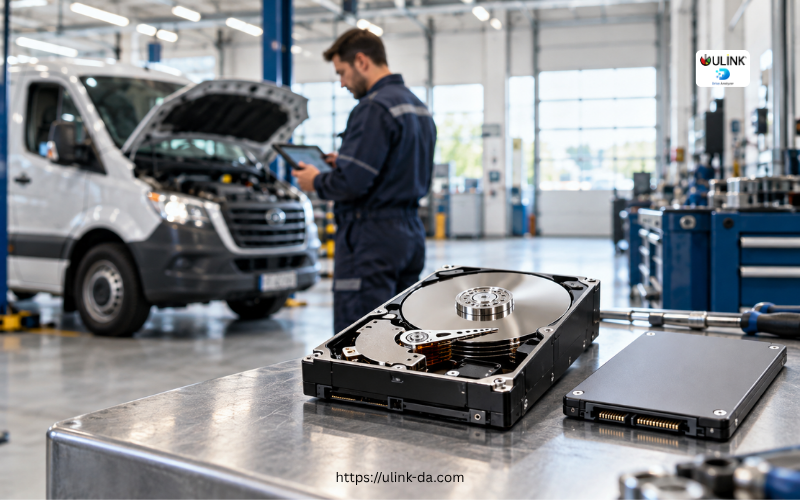
Introduction
AI is changing how we think about maintenance across industries. Instead of waiting for something to break and then responding, the focus is shifting to identifying failure before it happens. Predictive maintenance powered by AI is no longer a concept. It is already in use, and the logic behind it applies well beyond the industries where it first took hold.
How AI Works in Vehicle Maintenance
In vehicle maintenance, predictive AI is now a standard tool for fleet operators and logistics companies. Modern vehicles are equipped with sensors that continuously monitor engine performance, brake wear, fluid levels, and fault codes. AI models analyze that data over time, looking for patterns and anomalies that indicate a component is likely to fail before the driver notices any change in performance.
The benefit is straightforward. Instead of reactive servicing after a breakdown, maintenance teams can plan ahead. Work gets done during scheduled windows. Vehicles stay on the road. For fleet operators, where a single vehicle out of service affects delivery schedules and profit margins, this kind of early visibility has real operational value.
The reason it works is that AI does not evaluate a single data point in isolation. It looks at how multiple signals move together over time. One reading means little. A pattern across several indicators over days or weeks tells a much clearer story.
How DA Drive Analyzer Applies This to Storage
Storage drives generate health data continuously. S.M.A.R.T. metrics track indicators like read error rates, reallocated sectors, drive temperature, and wear levels. Traditional monitoring tools watch these individually and alert when a single metric crosses a threshold.
The limitation is that most drives do not fail by crossing one obvious line. Degradation builds gradually across several health signals, each within normal range on its own, until the drive reaches a point of failure. By the time a threshold trips, the process has usually been underway for some time.
DA Drive Analyzer by ULINK addresses this directly. Rather than watching individual metrics in isolation, its AI model analyzes multiple drive health signals together and tracks behavioral trends over time, identifying failure patterns before any single S.M.A.R.T. attribute has crossed a line.
The platform runs continuously in the background across Windows PC, macOS, QNAP NAS, and ASUSTOR NAS, with no manual scans required. First predictions typically begin within 24 hours of installation. Each drive gets a clear health status: Healthy, Moderate Risk, or Severe Risk, so users can act on what matters without interpreting raw data.
For those managing multiple devices, DA Monitor aggregates drive health alerts across connected systems in a single dashboard. DA Portal extends that with AI predictions, health history, and alert tracking across the fleet. Both require Cloud Mode and an active internet connection. For environments with stricter privacy requirements, Standalone Mode runs the full AI analysis locally with nothing uploaded externally.
Why the Parallel Matters
Predictive maintenance became standard in vehicle fleet management because the cost of a breakdown on the road was consistently higher than the cost of preventing it. The same calculation applies to storage infrastructure.
A drive failure that causes data loss, forces emergency recovery, or takes a system offline carries costs that go beyond the hardware. The value of early detection is time: time to back up, time to order a replacement, time to schedule maintenance without disrupting operations.
AI-driven predictive maintenance is already proven in high-stakes physical environments. DA Drive Analyzer brings that same approach to the drives your data depends on.
Start with a 7-day free trial, no credit card required.
Predict Drive Failure Before It Happens with Our Drive Health Checker
AI-powered drive health monitoring and diagnostic software for HDD & SSD drives on Windows PC, ASUSTOR NAS, and QNAP NAS
Try DA for Windows PCTry DA for ASUSTOR NASTRY DA for QNAP NAS