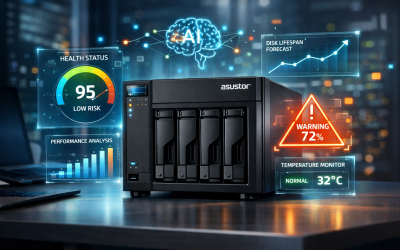
Whether you are managing a small business NAS, a home lab, or a data-heavy environment, one assumption is common: “If SMART says the drive is fine, everything is fine.” That assumption is where risk begins. Traditional NAS monitoring systems, including those built...
From Insight to Action: Smarter NAS Monitoring with Predictive Analytics
Moving from Insight to Action in NAS Monitoring Understanding the limitations of traditional monitoring is one step. Actively improving it is where real value begins. For ASUSTOR NAS users, the challenge is not access to data. It is making that data actionable. Most...
Beyond SMART: Using AI for Accurate Drive Failure Prediction
Self-Monitoring, Analysis, and Reporting Technology (SMART) has been the standard method for evaluating hard drive health for many years. It tracks key attributes such as reallocated sectors, temperature, and spin-up time, offering a basic view into drive reliability....
Redefining Storage Reliability with AI
Storage reliability has traditionally been approached through monitoring and response. Systems are deployed, metrics are tracked, and alerts are triggered when predefined thresholds are crossed. This model has been widely used to manage storage environments across...
The Future of Enterprise Storage Monitoring: Predictive Drive Failure and the Next Decade of Storage Reliability
Enterprise storage monitoring is changing. As storage systems grow larger and more distributed, traditional SMART monitoring and simple threshold alerts are no longer enough to maintain long-term reliability. The next phase of storage monitoring focuses on...
Why Most Drive Monitoring Fails When Decisions Are Needed
Drive monitoring tools have improved a lot over the years. Today’s systems can detect when values cross limits, surface SMART irregularities, and raise early warnings before a drive fails completely. Detection itself is no longer the issue. The real challenge starts...
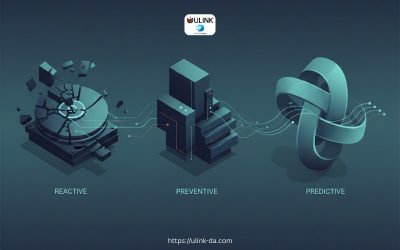
The Maturity Curve: Reactive → Preventive → Predictive
Modern IT environments depend heavily on storage reliability. From NAS devices and on‑prem servers to hybrid infrastructure supporting critical workloads, hard drives and SSDs remain a foundational layer. Yet many organizations still manage drive health the same way...
Why Drive Health Awareness Is a Strategic Advantage
In many organizations, storage drives are treated as background components that are only noticed when something fails. Yet drives support every digital process, from daily operations to long-term data retention. When drive health is poorly understood, decisions become...
How Intelligent Drive Monitoring Improves Long-Term Data Reliability
In today’s digital environment, data reliability is a fundamental requirement rather than a technical preference. Businesses and individuals rely on storage systems to ensure that data remains available, accurate, and consistent over long periods of time. From...
The Evolution of Drive Health Monitoring: From S.M.A.R.T. to AI
The importance of drive health monitoring has grown tremendously in the modern digital era. From businesses running global data centers to individuals safeguarding family memories on laptops, the performance and longevity of hard drives directly impact productivity...
Main Reasons for Hard Disk and SSD Disk Failure Everyone Should Know
We store everything on our drives — family memories, office projects, client files, and personal work. But what happens when a hard disk failure or SSD failure suddenly erases years of data? Most people believe these failures are unpredictable, but the truth is...
Drive Health Tips Every Gamer Should Know Before Tournaments
For gamers, nothing is more frustrating than a system crash or slow performance right before a big tournament. Competitive gaming demands not only skill and strategy but also reliable hardware. One of the most overlooked aspects of gaming preparation is drive health...